
Body Corporate Managers and Property Managers: Who Does What?
There is often confusion around the difference between a body corporate, a body corporate manager, and a property manager. For owners and tenants in commercial or mixed-use complexes, understanding where each role begins and ends can save a lot of frustration.
These roles are connected, but they are not the same. Each has a different function, a different responsibility, and a different relationship to the property.
The Body Corporate
When a property sits within a community titles scheme, each lot owner automatically becomes a member of the body corporate. This is not optional.
The body corporate exists to manage the common property and shared assets for the benefit of all owners. That can include things such as:
- common driveways and access ways
- shared services and facilities
- building insurance in many schemes
- maintenance of common areas
- enforcement of by-laws
- decision-making on matters affecting the scheme as a whole
In simple terms, the body corporate looks after the parts of the property that belong to everyone collectively, rather than the parts that belong to one individual lot owner.
The Body Corporate Manager
A body corporate manager is usually engaged by the body corporate to provide administrative support and help carry out the decisions of the body corporate.
This role may include:
- organising meetings
- issuing notices
- coordinating records and documents
- assisting with budgets and levies
- handling administrative communication
- helping the committee operate within the legislation
It is important to understand that the body corporate manager is not the body corporate itself. They are engaged to provide services to it.
That distinction matters because many owners assume the body corporate manager makes all decisions. In reality, major decisions are generally made by the body corporate through its committee and ownership structure, with the manager acting in an administrative and advisory capacity.
The Owner
The owner owns the lot and remains responsible for matters connected with ownership of that lot.
An owner may need to deal with both the body corporate and a property manager, depending on the issue.
For example:
- if the issue involves common property, by-laws, or body corporate records, it may sit with the body corporate or body corporate manager
- if the issue involves the tenancy, rent, lease obligations, or occupation of the lot, it is more likely to sit with the owner and their property manager
Owners are often caught in the middle when there is confusion about who should handle what. Clear understanding at the start can prevent delays and mixed messages later.
The Property Manager
A property manager is engaged by the owner, not by the body corporate.
Their role relates to the tenancy or occupation of the lot itself. In commercial property, that can include:
- rent collection
- lease administration
- managing tenant communication
- dealing with outgoings and occupancy matters
- coordinating issues inside the leased premises
- acting between landlord and tenant on day-to-day tenancy matters
While the term property manager is widely used, in many commercial situations the role is really closer to tenancy management. The focus is on the relationship between landlord and tenant, and on the operation of the leased premises, rather than on the management of the overall scheme.
The Tenant
A tenant occupies the lot under a lease, but if that lot is part of a body corporate scheme, the tenant must usually comply with both:
- the lease, and
- the body corporate by-laws
This is another area where confusion often arises. A tenant may assume they only answer to the landlord or property manager, but their use of the premises can still be affected by body corporate rules relating to access, signage, waste, parking, noise, operating hours, and other scheme-wide matters.
Why the Confusion Happens
The confusion usually comes from the fact that these roles interact with each other.
A tenant may contact the property manager about a problem that is actually a body corporate issue. An owner may expect the body corporate manager to act on something that is really a lease matter. A body corporate manager may be copied into correspondence simply because people are unsure who is responsible.
The result can be delays, frustration, and inconsistent communication.
The clearer everyone is on their role, the easier it becomes to solve problems quickly.
A Note on Consistency
One of the challenges owners sometimes encounter is that the quality and consistency of body corporate management can vary.
That is why it is important for owners to understand the structure themselves rather than relying purely on titles. Knowing who is responsible for what helps owners ask better questions, direct issues to the right person, and protect their interests more effectively.
A Simple Way to Think About It
A practical way to understand the difference is this:
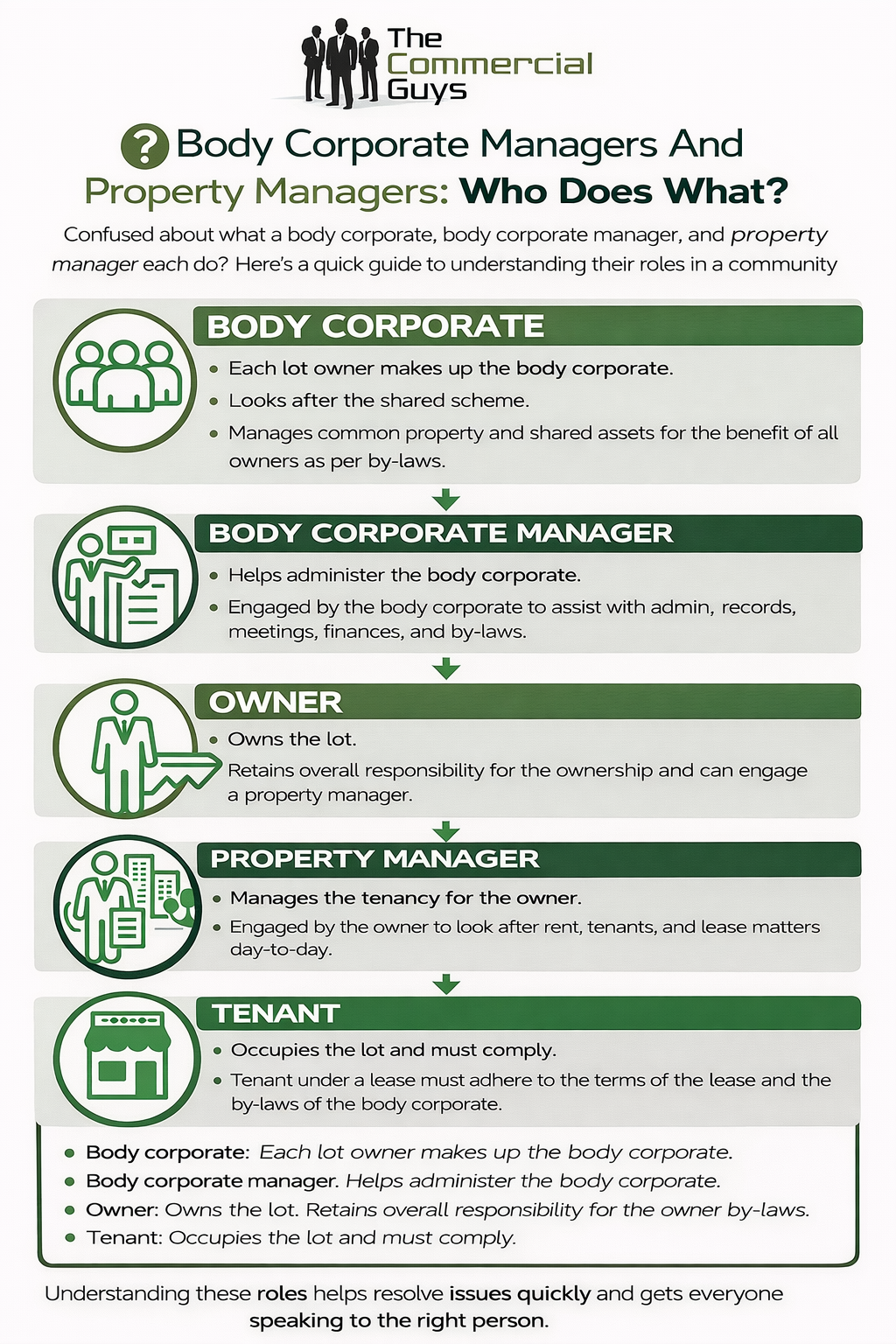
- Body corporate: looks after the shared scheme
- Body corporate manager: helps administer the body corporate
- Owner: owns the lot
- Property manager: manages the tenancy for the owner
- Tenant: occupies the lot and must comply with the lease and applicable by-laws
Final Thoughts
If you own or lease property within a body corporate scheme, it is worth taking the time to understand the different players involved. It can make a real difference when issues arise.
Knowing whether a matter belongs with the body corporate, the body corporate manager, the owner, or the property manager helps avoid confusion and keeps communication focused where it should be.
For owners in particular, that clarity can lead to better management outcomes and fewer headaches over time.
Written by Adam Leishman.
About The Commercial Guys
The Commercial Guys provide expert insights and guidance in the commercial property market. Our team helps investors, landlords, and businesses make smarter property decisions through market analysis, newsletters, and strategic advice.
Contact Our Team